

The Pitt Sustainability Literacy & Culture Survey is administered triennially by the University’s Office of Sustainability, with previous iterations in 2017, 2020, and 2023. The survey is designed to gauge both the understanding of core sustainability concepts and how respondents feel about Pitt’s emerging culture of sustainability. It also serves to satisfy two requirements for Pitt’s Gold AASHE STARS designation.
Similar to previous years, the 2026 Pitt Sustainability Literacy & Culture survey had 4 sections, including five additional literacy survey questions compared to 2023.
- Demographics (i.e., Pitt affiliation, school, department, major, etc.)
- Literacy
- 18 multiple choice questions, each with 1 correct answer
- 1 question asking about familiarity with different sustainability concepts
- Culture
- 12 questions relating to respondent sustainability practices, opinions, and preferences (with no correct answers)
- Topics included Pitt’s status as a leader in sustainability, respondents’ contributions to sustainability on campus, and ranking of campus sustainability priorities.
- Ideas & Feedback (1 open-ended question).
Demographics


Literacy Survey Results

Survey respondents answered 19 literacy questions designed to test their understanding of sustainability concepts related to the 3 pillars of sustainability: equity, environment, and economics.
2026 results mirrored 2020 proficiency levels, with almost 40% of respondents scoring 71% or higher. While this represents a 14% increase from 2023, the small number of literacy survey questions that year likely reduced scores. Regardless, strong sustainability literacy indicates that sustainability events and education are helping to build and mantain Pitt community sustainability knowledge.
94% of respondents selected the correct answer to the question: “Which of the following items are not related to sustainability?,” demonstrating an understanding of sustainability’s key pillars. However, only 28% of respondents correctly answered the question “Where should you dispose of a to-go hot coffee cup from Starbucks on campus?” The answer is the trash / landfill; these cups are not recyclable at Pitt.
Sustainability Concept Proficiency
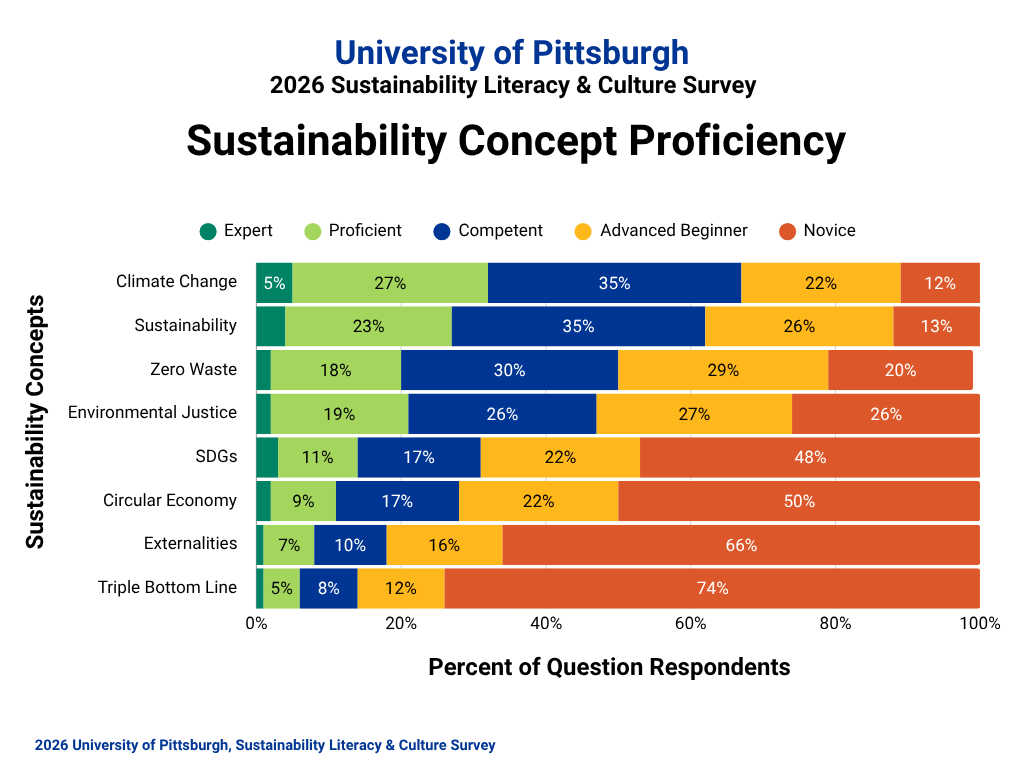
Starting in 2023, participants were asked to indicate their level of knowledge and familiarity with various sustainability concepts, scoring themselves from Novice to Expert.
Overall, 2026 respondents were more confident in their understanding of climate change, sustainability, and the concept of zero waste than 2023 respondents. On average, 50% of respondents scored themselves as “Competent,” “Proficient,” or “Expert” on the topics of climate change, sustainability, and zero waste. Reflecting 2023 survey results, respondents were less confident in their understanding of circular economy, externalities, and the triple bottom line. As trends were relatively similar across all demographic categories, this gap in understanding could be addressed in future Pitt sustainability education.
Culture Survey Results
The culture section of the 2026 Sustainability Culture & Literacy Survey gauges respondents’ opinions, preferences, and actions relating to sustainability at Pitt. Fifteen questions address perceptions of Pitt as a leader in sustainability, how Pitt incorporates sustainability in respondents’ daily lives, and their awareness of campus sustainability initiatives.
Sustainability Leadership
In 2026, 45% of respondents selected that they “strongly agree” or “agree” that Pitt is a leader in sustainability practices relative to other universities. Peak agreement with this statement was in 2020, when 51% of respondents agreed that Pitt was a leader in sustainability. Given the University’s nationally recognized status as a sustainability leader, effectively conveying and celebrating Pitt’s sustainability endeavors remains crucial for continued progress and campus engagement.


Sustainability Commitment

Prioritizing Sustainability Initiatives
Mirroring priorities since the survey’s 2017 start, respondents identified the top 3 most pressing campus sustainability issues as 1) Energy use, efficiency, and conservation; 2) Recycling, composting, and materials diversion from landfill; and 3) Climate change and reducing greenhouse gas emissions.
However, when breaking down responses by demographics, a more detailed understanding of concerns emerges, as indicated below. Understanding how different campus populations prioritize sustainability activities will help better inform programming and tailor resources we can make available.

Top 3 Academic and Engagement Initiatives
Regarding academic initiatives, 2026 survey respondents ranked their priorities for future focus as follows:
- Addressing real-world problems in courses
- Encouraging projects that advance sustainability in our communities
- Using campus as a living laboratory and/or proving ground.
For engagement initiatives, 2026 survey respondents ranked their priorities for future focus as follows:
- Enabling and promoting sustainable behavior
- Integrating sustainability into student / residential life
- Encouraging projects that advance sustainability on-campus
Both trends are consistent with 2023 results.
Individual Contributions to Campus Sustainability
When asked what they were willing to do to contribute to sustainability on campus, 2026 survey respondents replied that they were most likely to change their personal and decision-making behaviors. These two answers were the top responses to this question. The third way respondents were most willing to contribute was by learning more about sustainability. Responses were consistent across demographic categories. These were also the top 3 responses in 2023, albeit in a slightly different order.
Sustainability in Daily Campus Life


When asked to choose Pitt sustainability initiatives they were aware of, the top three responses were as follows:
- Water bottle refill stations
- POGOH bike share
- LEED certified buildings
POGOH bike share had the same recognition placement in 2023, with LEED certified buildings dropping from its first place recognition in 2020 and 2023.
Ideation
Respondents were given the opportunity to provide their own ideas for sustainability initiatives and/or activities at Pitt. A few common themes arose:
- Recycling (92 responses)
- Respondents desired more education and information on how recycling works on campus, both on how and where to recycle items and whether items are actually being recycled.
- Readers interested in this topic should check out the University’s Zero Waste webpage.
- Waste reduction and compost (42 responses)
- Respondents expressed an interest in increasing compost bins across campus, particularly in dining halls.
- Engagement and awareness (88 responses)
- Respondents want more ways to be involved in sustainability and the Pitt community; suggestions included volunteer clean-up days.
- Readers interested in campus service can start with Volunteer.Pitt.edu.
- Artificial intelligence (21 responses)
- Many respondents wanted to know how the University is reconciling increased AI usage (including its water and energy usage) with sustainability and carbon neutrality goals
Some responses included suggestions for initiatives or programs that already exist at Pitt, emphasizing the need for better University-wide communications about existing sustainability initiatives. Examples:
- A 10-cent rebate for those who bring a reusable cup to Pitt coffee shops
- Existing Initiative: BYOCup and Usefull reuseable to-go cups and containers
- Rentable reusable containers at the dining halls
- Existing Initiative: USEFULL reuseable to-go cups and containers
- A way to collect items from students during move-out so they can be donated elsewhere
- Existing Initiative: Move Out Clean Out, which happens every Spring
Generally, all 2026 Sustainability Literacy and Culture Survey results indicate that the campus community has a strong understanding of sustainability as a concept and remain strongly aligned with the University’s commitments to sustainability. However, students, faculty, and staff are not always aware of sustainability initiatives across campus. In addition to increased sustainability communications and initiative visibility, the campus community also wants more recycling education, which the Sustainability team is already ramping up for 2026-27.